
The company I worked for sold imported light fixtures, and behind the warehouse was a trash heap of returns that never got smaller.
My name is Douglas Kane, and my previous employer, an eCommerce lighting giant, sold products almost exclusively from China. I’m here to compare and contrast the elephant in the room when it comes to Made in the USA vs. Chinese Imports. I’ve been in the lighting business since 2015 and have seen thousands of products get introduced into the market, let me peel back the curtain. The eCommerce business was simple, buy from China, double the cost, and sell it. The amount of failures that came through the test lab was staggering, and the ones that made it to the store seemed good enough. Once the product hit full scale manufacturing, that is when we saw the quality nose-dive. Think shoddy weld lines, blinking LEDs, the complete wrong paint color, or lights that wouldn’t even turn on. I could see the returns heap growing before we’d even sold them. If a customer’s goal is to shop the lowest price, then by all means, an import is your best bet. Are you prepared to take the risk?
Fake specs, ignorant specs, or a straight up lie
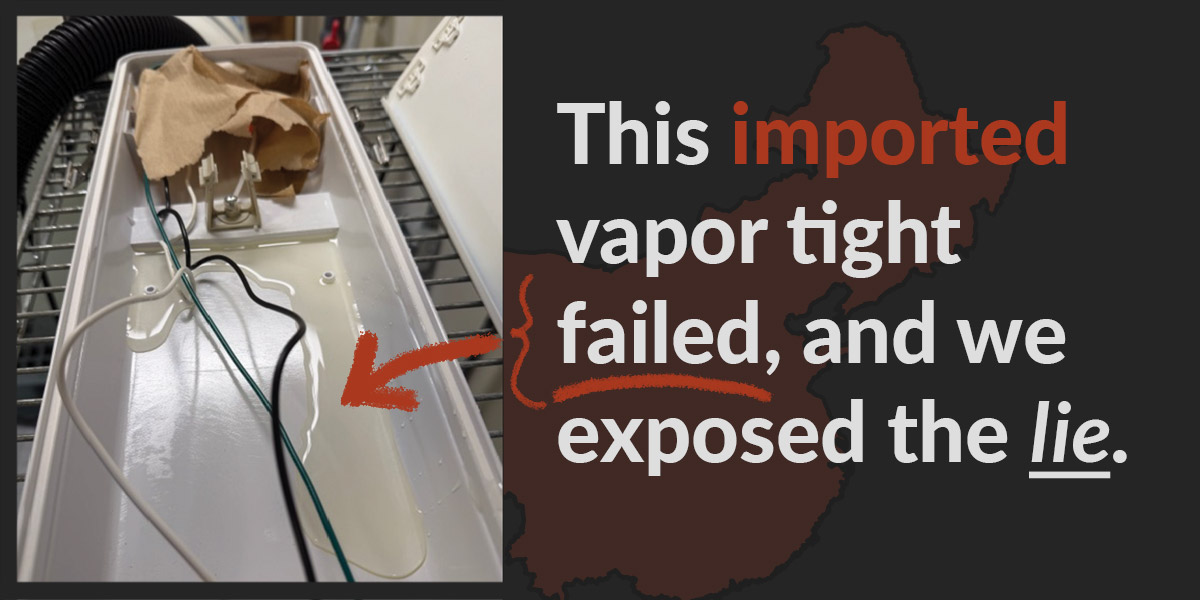
We bought an imported vapor tight and sent it out for testing to see how it stacked up against ours. Its spec sheet claimed IP66. In testing, water got inside the fixture. A failed IP test! That’s why testing is so important, because nothing ruffles my feathers more than being lied to. A smart consumer needs to know that the specs can be wrong, and not to trust them blindly.
Another huge glaring problem is when products are mislabeled. Maybe they say they are made in the USA, but really are imported fixtures with a little USA flag sticker on them. Safety marks get faked, too. In 2023, CBP officers at International Falls, Minnesota intercepted over 7,800 lighting fixtures from China with counterfeit UL marks. CBP fined the shipments $100,000 and seized and destroyed the fixtures.
When our spec sheet says IP66, it’s because the fixture passed IP66 testing. Ask us for the results anytime. Amersol builds vapor tights in Missouri, and they are made to pass the certifications that matter most. Check out the IP ratings guide to understand more about our testing.
When it comes to a failed unit, look to the driver
Building a light fixture is like a recipe, different components have to be balanced together for light output and longevity. The biggest factor as to why LEDs fail is not usually the diode itself, but the driver. That’s why each fixture ships with a high-end Signify driver. Signify has a real engineering claim: it tells you what percentage of drivers should still be working, and under what heat conditions. Signify drivers also list open load, short circuit, over power, over temperature protection, and a 5-year warranty. The choice becomes clear, choose Signify and trust it, or a no-name driver and trust a blind faith decision.
Elephants in the room
Chinese manufacturing workers earn roughly $6 to $7 an hour. In the USA, the average manufacturing worker earns about $37. The sheer scale of their manufacturing and production also plays a role. The cheaper fixture saves money up front, but it costs more when hiring an electrician to come back to replace it.
You’re a wiser customer now. So next time you’re shopping for the perfect fixture, ask for independent test results, verify the UL or ETL listing number, and check the driver datasheet. You’ll save yourself from having to add another dead light fixture to the returns heap.