
DLC Vapor Tight Lights:
Why DLC Qualification Matters
What DLC Qualification Means
DLC stands for DesignLights Consortium, a nonprofit that sets performance standards for commercial and industrial LED lighting. Qualified fixtures appear on the Qualified Products List (QPL), and that listing is what unlocks utility rebate money across most of North America.
DLC Premium is a higher performance tier on the same list, though as of 2026 few utility programs pay extra for it specifically.
DLC is not a safety certification, and that is the most misunderstood thing in commercial lighting. UL and ETL answer one question: will this fixture hurt someone. DLC answers a different one: will this fixture deliver the efficiency it claims. Getting on the QPL requires independent LM-79 photometric testing, TM-21 lumen maintenance data, and driver documentation reviewed by a third party instead of taken on faith from a spec sheet.
Why It Matters
Rebates run through the QPL. Roughly 700 utility and efficiency programs across North America require QPL listing for eligibility. If a fixture is not on the list, the rebate application does not get denied so much as it never gets started. On a warehouse or processing plant running a hundred fixtures, that gap often decides whether a retrofit gets funded this year or next.
Specs require it outright. “DLC qualified or approved equal” is now standard language in commercial specifications and public bid packages. It lets a specifier filter out unverified product without auditing every manufacturer’s claims. Not on the list means not in the conversation.
It is verified performance, not marketing. Anyone can print 150 lumens per watt on a PDF. DLC qualification means an accredited lab produced that number on the actual product being sold, and anyone can look it up by model number.
What It Takes to Get a Product Listed
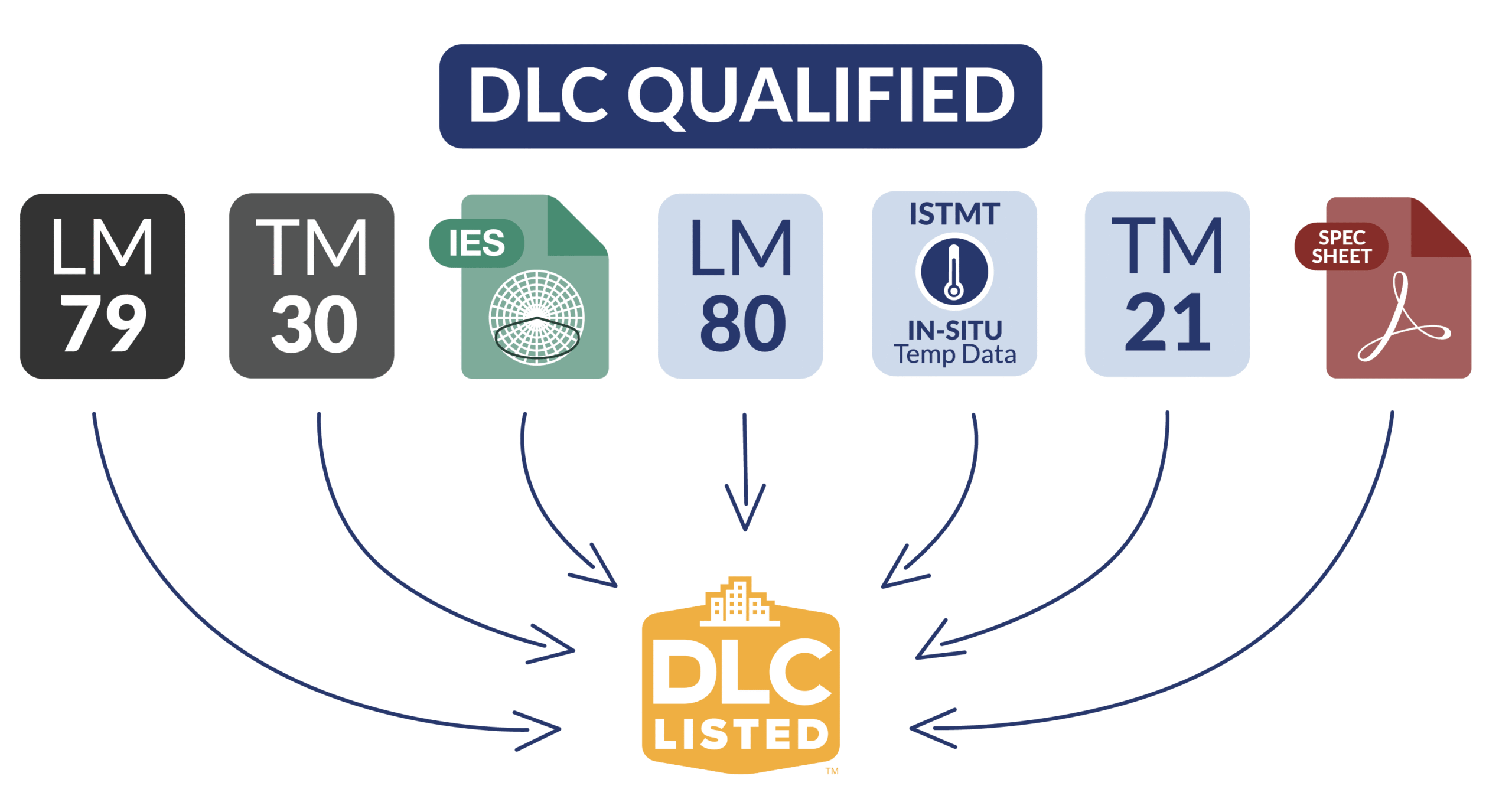
Qualification is not paperwork. Every fixture on the QPL is backed by a package of independent test data, and that is why a listing carries more weight than a spec sheet claim.
LM-79. Photometric and electrical testing of the complete luminaire by an accredited lab. This produces the efficacy, lumen output, CCT, and color values that appear on the QPL. V6.0 requires LM-79-19 or -24.
TM-30. Color rendition reporting, describing fidelity and gamut more completely than CRI alone. Derived from the LM-79 spectral measurement.
IES file. The photometric distribution file generated from LM-79 data. This is what lets a designer model the fixture in a layout before anything gets installed.
LM-80. Lumen maintenance data for the LED package itself, measured over thousands of hours and supplied by the LED manufacturer.
ISTMT (in-situ temperature measurement). Thermocouples record actual operating temperature at the hottest LED and at the driver case inside the real housing. This determines which LM-80 dataset applies to your fixture. A luminaire that runs hot fails here even when the components on paper are good.
TM-21. The projection that combines LM-80 data with the measured in-situ temperature to produce L70, the point where output falls to 70 percent of initial.
Spec sheet. Product documentation, including the minimum five year warranty DLC requires on every listed product.
All of it goes to DLC with the application, and once approved, the DLC icon is added to the product spec sheet and web page.
DLC Rebates Vary Widely by State
DLC listing establishes eligibility. Individual utilities and state programs set the actual amount, so the same fixture can earn very different incentives depending on where the project sits. Some also require pre-approval before install. Confirm both before you order.
The 2026 Deadline Worth Knowing
DLC released SSL V6.0 in final form, replacing the V5.1 requirements that had stood for about five years. V6.0 took effect for applications in January 2026 and raises efficacy thresholds substantially across categories.
- October 9, 2026: V5.1 products must be updated to V6.0.
- December 15, 2026: V5.1 products not qualified under V6.0 are delisted.
If you are specifying for a project closing late this year, a fixture that is listed today may not be listed when the rebate paperwork gets submitted. Ask the manufacturer which version their qualification is under.
Common Questions
No. UL and ETL cover electrical and fire safety. DLC covers efficiency and light quality. Good commercial fixtures carry both.
DLC’s own term is “qualified,” and products appear on the Qualified Products List. Both terms are used in the field and mean the same thing.
No. A fixture has to meet published performance thresholds for its category and be submitted, tested, and approved by DLC. Many low cost vapor tights are not on the Qualified Products List at all.
Usually not through a standard prescriptive program. Some utilities offer custom incentive paths that evaluate the project rather than the product, but they require more documentation and take longer.
Yes. DLC listing establishes eligibility, but rebate amounts are set by individual utilities and state efficiency programs. The same fixture can earn very different incentives depending on location and whether the program is prescriptive or custom.
Browse Our DLC Qualified Products